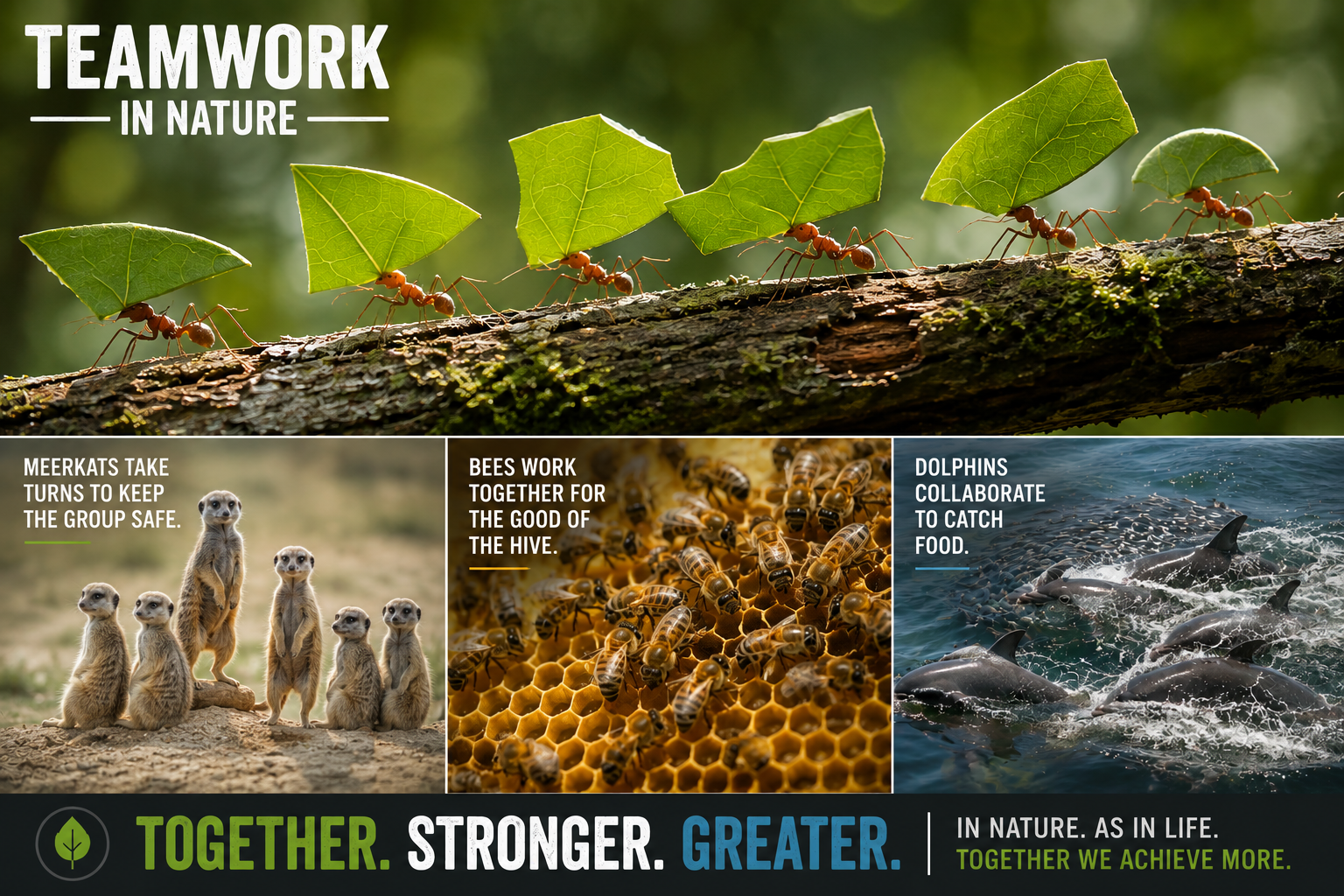
What does teamwork look like

Teamwork is often described with sports metaphors, but in practice, it’s less about a highlight reel and more about the invisible "glue" between people. It is the transition from "What do I need to do?" to "What do we need to achieve?"

Here is a breakdown of what effective teamwork looks like across three key dimensions.

1. The Behavioural Indicators

If you were a fly on the wall in a high-performing team, you would see:

  • Active Listening: People don’t just wait for their turn to speak; they ask clarifying questions to ensure they understand their teammate’s perspective.
  • The "Pass": Just like in basketball, someone with a good idea passes it to the person with the best "shot" (the right skills) to execute it, regardless of hierarchy.
  • Constructive Friction: Teamwork doesn’t mean constant agreement. It looks like healthy debate where the focus is on solving the problem, not winning the argument.
  • Shared Wins and Losses: No one says, "I did my part, but they failed." Success is a collective celebration, and failure is a collective post-mortem.

2. The Functional Components

For teamwork to actually produce results, it requires a specific structural setup:

Element What it looks like
Role Clarity Everyone knows their specific "lane" so they don’t trip over each other.
Trust Team members feel safe admitting they made a mistake or don’t know an answer.
Common Goal A clear "North Star" that guides every decision and priority.
Reliability Teammates do what they say they will do, when they say they will do it.

3. The "Invisible" Signs

Sometimes the best teamwork is what you don’t see:

The Ego Check: It’s the moment a senior leader steps back to let a junior employee lead a meeting because that employee has the most expertise on the topic.

  • Anticipation: Teammates begin to anticipate each other’s needs. If "Person A" is overwhelmed, "Person B" steps in to take a task without being asked.
  • Psychological Safety: The environment feels "low-stakes" for sharing creative (and sometimes bad) ideas, which is where the best innovations eventually come from.

Uncovering the need for Ai in your business

To uncover the real operational need for adding AI to an existing contact centre, you must look past the technology hype. You need to identify specific friction points, cost drivers, and data gaps in your current setup.
Here are the top 15 questions to audit your existing infrastructure and discover if AI is truly necessary.

Current Technology & Infrastructure

  • What specific software vendors handle your current routing, telephony, CRM, and ticketing?
  • Where do data silos exist that prevent a single view of the customer?
  • What are the licensing costs and contract end dates for your current systems?

Operational Pain Points & Efficiency

  • Which routine, repetitive questions consume the highest volume of agent time?
  • At what specific points in the customer journey do users abandon self-service?
  • How much time do agents spend searching internal databases during a live call?
  • What manual, post-call administrative tasks take up the most agent time?

Performance Metrics & Cost

  • What are your current baselines for Average Handle Time (AHT) and First Contact Resolution (FCR)?
  • What is your cost-per-contact across voice, email, chat, and social channels?
  • How many interactions are abandoned entirely due to long queue wait times?

Customer & Agent Experience

  • What are the top three complaints found in your CSAT or NPS survey feedback?
  • What is your annual agent turnover rate, and what drives their exit?
  • How do you currently identify and support frustrated customers in real-time?

Data, Insights & Quality Assurance

  • What percentage of total customer conversations does your QA team manually review?
  • How do you currently track emerging trends or sudden spikes in product issues?

Get in touch if you could do with some help or a fresh pair of eyes on your current challenges

When is a Contact Centre, NOT a Contact Centre

Imagine asking 100 people to describe a Contact Centre. Most would likely envision a bustling office space with employees wearing headsets, sitting in front of computers, and handling phone calls. This common perception, however, limits our understanding of what a contact center truly is and inadvertently excludes other businesses from recognizing themselves as part of this ecosystem.

Yet, there’s a missed opportunity in this narrow perspective. Consider the remarkable advancements in Contact Center Technology.

Technology evolves rapidly, often leaving us struggling to keep up. Just think about the capabilities packed into your latest iPhone or Android device—it’s more powerful than the technology that once took us to the moon.

The ongoing technology revolution brings both complexity and immense capability. Unfortunately, the terminology itself sometimes leads to exclusion, preventing businesses from realizing the substantial benefits available.

Consider this scenario: A business leader or owner dismisses the idea of using contact center technology because their company doesn’t fit the traditional contact center mold.

Remember, every business relies on customers for survival. These very customers interact with your business, reaching out and receiving responses. Are you following so far? Excellent.

These customers are part of the same ever-changing cycle as we are. They, too, embrace technological shifts. Moreover, consider how the demographics of your customer base influence the transition from “real-time live voice” conversations to more digital, near-real-time, or asynchronous interactions—think WhatsApp and similar channels.

Ignore these changes at your peril, because we all know that customers will vote with their feet if you are not able to offer them the flexibility and choice that they demand of us.

This is not about Tech for Tech sake, but embracing the inevitable change that is happening with or without us. 

A word of caution, however. Do make sure that you plan this well and consider the fallout should you get this wrong. And some of the wrongest (I know, but it felt right to use the word) implementations are from some of the largest companies on the planet – why – I can only surmise that they feel they CAN, because they are the 400lb gorilla – but we all know they are wrong don’t we.

So my advice would be to dip your toe in the water and introduce these emerging DIGITAL channels into your NON-CONTACT CENTRE businesses and do it well. Making sure that you are not building them in siloes, but doing it in a joined up and connected way (Omnichannel) that keeps real people at the heart of the changes – your staff and your customers. 

Equally I would also investigate how AUTOMATION can better serve your customers – including Artificial Intelligence solutions using Generative AI. Although there is a place for less sophistication for some interactions 

Want some help and advice – just ask. I don’t bite, even as a Leicester Tigers 🐯supporter 😜

No one is just TOO BUSY!

We hear it all the time, don’t we, and sometimes coming from our own mouths!


But what does it actually mean?

Life can be pretty hectic, with noise all around us and demands on our time and attention like never before. The digital world can become overwhelmingly distracting, with notifications pinging incessantly on our devices.

Ultimately though, we are in much greater control than we might think. It is also true that we make time for what is important to us. Or more accurately that which we believe should be important to us. After all, there is (for most of us anyway) nothing more important than our loved ones. But do we always make time for them, or do we succumb to the pings of our other attention seekers?
I often wonder if this is a self-induced state by building our importance so that we attract way more attention than is necessary. Should we instead, be ensuring that we are setting ourselves up better for getting out of the way, and reducing our personal involvement in matters that really do not need us?

It is worth asking yourself what you are currently involved in that you could easily step away from – you may just surprise yourself and your family and friends will thank you.

I haven’t made any New Years resolutions

No specific NY resolution from me

However…

> I will continue to work on personal growth every day.

> I will continue to challenge myself to be an outstanding human being every day.

> I will work diligently on my commitments every day: both business and personal.

> I will work on business development in Trust Partner Services Ltd every day.

> I will declutter my connections. Where I am no longer needed, I will disconnect, making room for fresh engagement.

Wishing everyone a very
rewarding and contentment filled 2023

Happy New Year

We’re in – are you? – Trust Partner Services Ltd

https://www.trustpartnerservices.com/trust-joins-the-chamber/

Trust partners with the Herts Chamber

Having watched from the sidelines for some time, we decided it was time to roll up our sleeves and join the fray.

We are now officially members of the Hertfordshire Chamber of Commerce and it is our intention to be a fully active member of this illustrious group.

Our WHY for this is a strong desire to be a supportive local business for other local business and to investigate further ways of acting more local. For as long as I can remember, our approach has been international, and that will remain, but we would like to become way more active locally. This is therefore, the first step into understanding the local landscape. We want to listen and learn and support where we can, as we understand our role.

Looking forward to meeting other chamber members and learning about our local business eco-systems


© 2022 Trust Partner Services Ltd Trust Partner Services LTD

Not quite a public service announcement

What’s a great piece of tech, or app that you’ve discovered and can’t believe everybody isn’t using it?

what3words /// The simplest way to talk about location

w3w

There are so many great use cases for this mapping technology, especially in remote or busy locations. A great use case example for me was a recent weekend break in a very rural location on a sprawling farm with no signs and several different holiday cottages.

We had ordered a takeaway and provided an address (of sorts), which, with the best will in the world was still vague at best.

Enter “what three words” and we were able to provide a pinpoint accurate location that didn’t rely on a vague postcode or mapping address.

I reckon it’s a bit of a game changer even if perhaps could be considered a bit niche.

I have no doubt that there’s a whole world of other technology/applications that I’ve never even seen or used yet that could be a game changer for me or indeed for you.

Why don’t you share your game-changing tech story so that we too can benefit from the experiences that you’ve been having?