What it means to be a trusted advisor

The most successful sales professionals don’t wait for customers to tell them they have a problem—they help customers identify opportunities and challenges before they become business issues. That is the difference between being a supplier and becoming a trusted advisor.

Building trusted relationships requires a balance of proactive engagement and easy accessibility. Proactive engagement means maintaining regular contact with customers, understanding their evolving business priorities, monitoring industry trends, and bringing forward ideas that deliver measurable value. Rather than focusing solely on products or renewals, effective sales leaders initiate conversations around business outcomes, efficiency, growth, customer experience, risk reduction, and innovation. Customers value partners who help them think ahead rather than simply respond when something goes wrong.

Equally important is ensuring customers have multiple, convenient ways to engage when they need guidance or support. Whether through account management, customer success teams, technical specialists, digital channels, or executive sponsorship, customers should always feel they have access to knowledgeable people who can provide timely advice. Trust is built not only through regular planned interactions but also through being responsive and available when expertise is needed.

To support this approach, organisations need access to a broad portfolio of complementary solutions. Very few businesses can meet every customer requirement with their own products alone. The strongest sales organisations recognise this and develop credible partnerships with trusted technology providers and service specialists. These partnerships allow sales teams to solve a wider range of customer challenges without compromising quality or integrity.

Customers rarely judge you by the size of your product portfolio; they judge you by your ability to solve their problems. Having a carefully selected ecosystem of partners enables sales professionals to recommend the most appropriate solution, even when it extends beyond their own organisation’s capabilities. This reinforces credibility and demonstrates that recommendations are driven by the customer’s best interests rather than by a desire to maximise product sales.

An ecosystem approach also positions the sales team as a strategic business partner rather than a transactional vendor. By understanding the customer’s long-term objectives and drawing upon both internal capabilities and external expertise, sales professionals can deliver complete solutions that evolve alongside the customer’s business.

Ultimately, trusted advisor status is earned through consistency, expertise, and genuine customer focus. It requires proactive engagement that uncovers future opportunities, responsive channels that encourage customers to seek advice whenever they need it, and access to a broad range of solutions delivered through both in-house capabilities and trusted partnerships. Organisations that combine these elements build deeper relationships, create greater customer loyalty, and generate sustainable, long-term revenue growth based on value rather than transactions.


How does trust impact openness and collaboration?

Friend or foe

I am naturally open and have a leaning towards trust as a default, until of course I’m bitten or receive some other signal that I’m being used.

I have been reading a lot of books and other content about this broader topic, but not as a central theme. The themes were much more about ideas and sharing and how magical things can happen. The topic of trust and its impact doesn’t seem to figure highly, but I do wonder whether this can limit collaboration if there’s an unsaid trust question somewhere in the “group”

Is the elephant in the room?


Can ideas truly flow unencumbered, if there are (unsaid) issues within a group, whereby the trust question is not addressed?

Will all group members really bring their collaboration and sharing “A” game I wonder?

Does it matter if some are open in spite of this?

Personally, I’d postulate that it’s not optimal if you’re not all equally invested and some are holding back.
So is the answer that all parties sign some kind of NDA? Does this work in practice, or is an NDA now so default in business discussions, that they’re all too easily signed and filed without real attention and commitment?

All these questions bubble to the surface often for me, as the topic has huge significance to the work that I undertake. So all of this relies on a high degree of trust.

Making progress (and quickly) is rather tricky without it

Physical exhibition events are back it seems

Very recently (well about 7 weeks ago to be more precise), we participated in the annual Channel Live expo, held at the NEC in Birmingham.

We have exhibited there a few times with our partners and had some decent engagement, and this time was no exception. In fact, I would chalk this one down as one of the most successful, in terms of actual potential partnership opportunities for our current vendor partner Inovo Telecom.

AI and Automation

My business partner and I had been asked to participate this year, as presenters for a couple of the theatre topics – “AI and Automation”; and “Creating Sticky Customers”.

Despite it being quite some time since presenting to an audience like this, I was really excited and as a result hugely enjoyed my session, which is a topic I have a particular passion for anyway (thankfully)

Enjoy

Why “we never get asked for that” is a terrible response

Care to join the debate?

When you are considering your business operations, with a thought for your portfolio of offerings and what your prospective customers seek you out for, do you ever find yourself saying to potential suppliers “we never get asked for that”?

Do you also ever stop to consider why that might be? Could it be that it is so far away from your core business activities that it just wouldn’t happen – e.g. are customers likely to ask an IT reseller for HR assistance? Could it be that your business is seen as a very niche provider? Could it be that you seem unapproachable, or that your skillset is focussed?

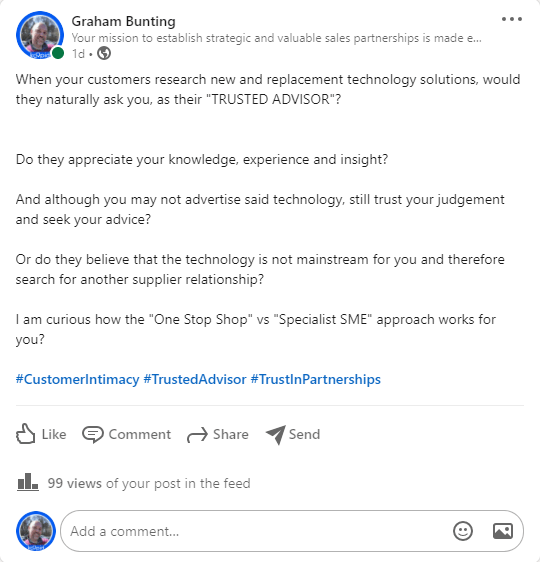
Whether or not any of these reasons apply, wouldn’t you like to grow your business by helping more customers solve more business problems and you are their “go-to” person for all advice? For me, “Trusted Advisor” is an extremely aspirational position to be in where your knowledge, experience, and opinions are deemed valuable

Agree? Whats your view?

I’ve got all the technology I need ok!

It often feels like there’s always someone trying to sell us something doesn’t it?

If not now, then when?

And that’s certainly true to some degree, because there’s always something new to be sold. That’s the nature of innovation and progress.

However, there’s often a lot of great technology already invested within a business, but it’s just not been put to good use for some reason. It could be lack of knowledge, or loss of knowledge with staff movements, or supplier relationship continuity issues. Whatever the cause, help is at hand

As experienced business and technology consultants, Trust Business Partners offer technology agnostic consultancy that help you evaluate your position and plot a map of development activities to get you where you want to be, and no product brochures in sight.

If you’re keen to grow and develop your business and don’t think you need even more technology adding, then contact us to find out how we help.

People + Technology + Know how = Growth