How do I stay on top of the constant changes?

#TrustInPartnership

Whatever your perspective, I think we would all probably agree, that for the IT and Telecoms reseller, things have certainly changed, and continue to do so. The vendor landscape continues to evolve too, with new vendors appearing, with innovative offerings, and many established vendors consolidating as they vie for position in an increasingly crowded marketplace.

For the consumers of the technology (the customers), things are forever changing too. Factors affecting their businesses are arriving at such a pace, and with their business cost base being under constant pressure, many are running on very lean staffing numbers. This compounds to effect somewhat.

What we have is more change and a greater pace of change, more vendors, more innovation, fewer staff, greater challenges and the same amount of time in each and every day.

How does a business stay on top of all of this and remain current with technology that can give them an advantage, or stop them being exposed, as well as attract and retain staff as a great place to work.

In life, and in business, for me, it’s about relationships – building trusted relationships, where over time you can outsource some of this to a specialist or specialists – ensuring you can focus on the business of running your business – and generally, the smaller specialist businesses are more likely to offer you the long term relationship building opportunity, as they are more often than not, owner-run and they are therefore unlikely to leave the business to work at a competitor, leaving you with the what to do dilema.

#ShopLocal #BuyLocal #SupportLocal #TrustInPartnerships

Accreditation – A burden or a blessing

Vendor accreditation programmes – who are they really for?

1. Customers?
2. Channel partners?
3. Vendors?
4. All three?

Why does a customer care if their supplier is accredited by the vendor of the product, solution or service?
Why does a channel partner care whether they are Bronze, Silver, or Gold certified?
Why does the vendor need to create training and certification material, courses, tests etc?

It all sounds a lot of work, so why does anyone bother?

There must be some significant value in order to motivate everyone to care enough to get engaged – so what is it?

Customers are what this is all about! Customers require good advice from well informed representatives from the channel community and the channel community cannot rely on the resources of the vendor at every engagement they have, so the channel partners need to become equally well informed – This requires training and testing, which is great for the vendor, because they end up with well informed channel partners representing them and provides the scale required to develop more market coverage. In addition, an accreditation programme usually has a volume\revenue related metric, which rewards the successful sales partner – more of a value component than a quality component and an often thorny topic for engineering heavy partners with lots of skills but not too many new sales. Customers are usually able to see for themselves what partner accreditations are for channels and select based on a value\quality blend. In reality most customers want to know they will be well looked after rather than well sold to.
For the vendor, an accreditation programme provides a sense for channel partner commitment levels and focus on their portfolio, and training enables current knowledge to be maintained and product knowledge to be broadly well ingrained. The more a channel partner commits to one vendor programme, the less time and resources they will have for competing offers – stands to reason. So vendors see this as an important dynamic for developing partner commitments. Ultimately this enables scale and quality delivery for the customers and commitment for the vendor, with the reseller having the ability to wrap services and complementary products to their solution.

Practice (alone) does not make perfect

Like all walks of life – work, sport, school – if you are practicing the wrong things, or the wrong way of doing something, you are simply repeating your errors over and over – frustrating and clearly limiting your success.

So how do you stay on track with the right things to practice? Clearly a good start point is to exercise good self discipline. This is the foundation for any personal development. Thinking that the issue is “not my fault” and the issue is caused by something “out there somewhere” is a sure fire way to have reduced control of your life. The first step therefore is to take control of yourself and your discipline including your thoughts and “self-talk”. Be sure to catch yourself talking positively with a “can do” attitude, and stop the cannot do and self limiting speak.
Finding a good coach is a smart step too – whether this is within your current role or an objective outsider. A good coach understands that as an individual, you already have all the necessary resources available to you, but they are the difference, that makes the difference.
For example, if I’m playing golf and struggling to get the results I desire, it probably makes sense to have a coach watch what I do in order to help reflect the areas for improvement – I recall this very real example where the golf pro explained to me (after watching me for a while) that he saw the problem with my game. He noted that I was trying to hit the ball…. Seemed initially to be a ridiculous comment…on closer inspection however, he was absolutely right. He went on to explain to me that if I swing the club, the club will hit the ball…. He moved my focus away from my desire to knock the ball into next week (and missing badly), into simply swinging the club accurately and all would work out.. On this occasion, I saw an instant improvement, but of course, the challenge is to keep making those improvements regularly and being consistent. This is something that your coach can bring to your performance.
This same coaching approach will produce a similar effect in sales. The challenge is that many sales managers and business owners are not well equipped to fulfill his role, so your best option is to find an external coach and develop the right habits.

Transformation – things have changed

Digital transformation means many different things to different people and there is a glut of offerings in the market currently that promise you a life of luxury if you take their latest solution for your transformation journey. One of the most impactful solutions that I have witnessed is one I will write about here; It’s from a vendor called Nureva and is available exclusively here in the UK from distributor Ascentae.

Nureva Span is a cloud-based software (and hardware) solution – simply a licence that enables collaboration on any device anywhere you can connect to the internet.

So what?

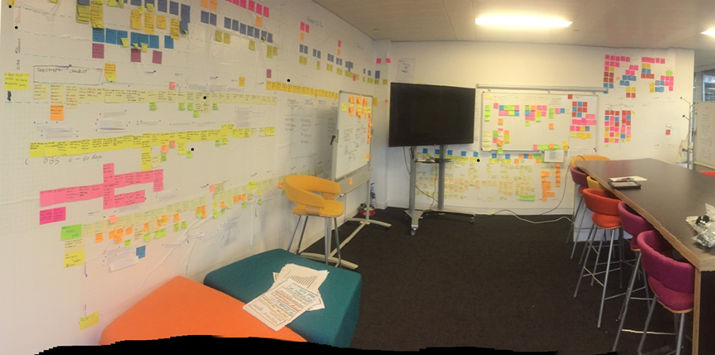
Well this is the really cool part (as if that wasn’t already cool enough) – Span is a virtual canvas – a virtual white board that allows users from wherever they are, to write, draw, or place virtual Post-IT™ notes onto the virtual board. Share desktop content, add comments with virtual INK, and even follow other users who are leading a discussion – so you are quite literally ALL ON THE SAME PAGE. All users connected to the “canvas” see all of added content and contributions, as you would if you were all in the same office sticking physical notes onto a physical wall and writing comments with a marker pen.

Because th

is is a virtual canvas, there is no issue with Post-IT™ notes falling off the wall, or the issue that many security conscious business experience, in that the physical office with the physical Post-IT™ notes must be secured when empty and cannot be accessed….. With Span, you simply close the canvas and it is secure.

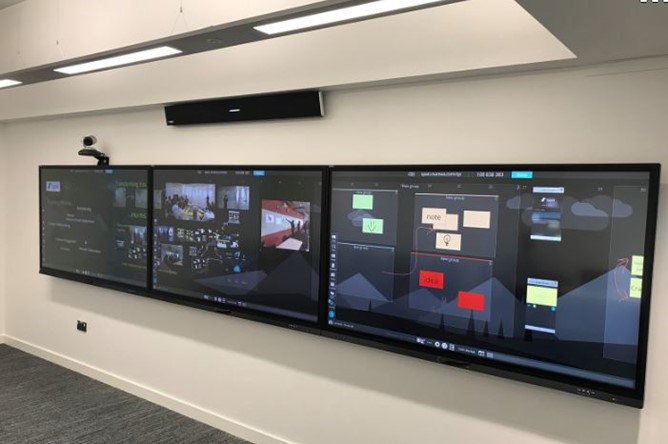
Take this to another level, and SPAN can be used on physical touch screen panels – multiple panels connected in software to provide a scrolling wall covering of virtual canvas. Huge real-estate for collaborators to work together on, in the same location, joined by remote participants in other locations with similar hardware components, or sat on a lounger connected via Wi-Fi or 4G on an iPad or similar device…..

This opens so many possibilities for commercial enterprises as well as for education – imagine a collaboration session finishing without the need to take your smartphone and take photos of the walls for some poor sole to spend several hours deciphering and writing up to share amongst the collaborators – That is digital transformation

Interested to learn more or perhaps have a demonstration – then drop me a note and I’ll be happy to arrange

Sales – Art or science?

Selling – is it an art or a science? not giving in

In truth, it’s both. The process of a non- customer becoming a customer through their buying process, has a bucket full of potential twists and turns to arrive as a new customer to your enterprise.

The science of selling is in the planning and understanding of how to get from where you are, to where you want to be. How you reach your target audience and what will attract them to your online presence (the NEW Shop window). The art component is to do with your engagement with the potential customer.

However you consider customer acquisition, you need to attract or find new ones and take care of and nurture the ones you already have. Rest assured that someone will be trying to lure your customers away from you, just as you are attempting to encourage new customers into your care.

The one universal truth is that this does all take some time, so do not expect to have orders rolling in because you have launched your web site or because you have received 3 inquires this week. Building your business is a long game, so stay ambitious but realistic and keep trusting the process, and above all be persistent and professional.

Business or consumer?

It’s an interesting distinction often discussed related to the customers you serve with your products and services. The lines became blurred some time ago as the world changed. I’m referring here specifically to the market for communications and mobility. I’m clearly just a regular member of society and as such am clearly a consumer, however, for most of the week I’m a business man. During the week I constantly flip between personas dependent upon the thoughts and actions at hand.

Today is Sunday and I’m heading to a business meeting starting tomorrow morning and therefore my persona is probably more confused than usual, but I look around a very busy train into London, and it’s full of people using their mobile devices to access what’s important to them now. It may be that there are others like me who are travelling to a business oriented activity, or more likely (based on overheard conversation), they are heading to something more recreational. Whatever we are all doing, it’s clear that mobility in our lives is very much mainstream, whether for business or consumer oriented use. What else is clear is that on order to get the maximum advantage from technology on the go, the device needs connectivity. For me, about to embark upon international travel, I’m considering cost avoidance and inconvenience, so I’ll be ensuing that I’m connecting to WiFi wherever I can, and I’ll be relying upon my ipass app and service to do the heavy lifting. I suspect that the people within the Enterprise customer base that also use ipass are similarly taking advantage of this benefit when they are not “at work” or in “business mode” – well why not?

Is Partner becoming an overused term for suppliers?

I was musing language (as I often do) again today and thinking about the initial engagement in any situation, but probably I was thinking mostly about the very first engagement in a sales situation. This could be a conversation, either by phone or face to face, or more often these days, an email or other form of non-real time communication. Whatever the channel, I was considering the impact of language and in particular the meaning that the recipient makes of the words and structure of those critical first few phrases. I am a firm believer that the conversation needs to be about “the client” and not about me and more importantly what the purpose of the contact is! This thought process led me to consider the positioning of the potential relationship and the consideration from the recipient’s perspective as to whether this was at all important at this early stage, or actually at all.

Inevitably when language becomes mainstream, or commonplace, it loses some of its caché and “advantage” (if it ever had any), and can become almost counter-productive as we see it as “hackneyed” or over-used, and this could be the case if positioning yourself as a partner – rather than just another supplier.

I like to seek out relationships whereby my value can be of real benefit to a client and that is all about “valuing the difference”. In this case the difference is the particular skills and knowledge I have acquired over many years in the telecoms and Unified Communications space, and that which can be of use to the client. I might frame this as me being a “partner” rather than a supplier, i.e. my value is not about a race to provide the lowest cost items, but about taking the stress out of understanding the options and possibilities as well as the unique aims and business values the client holds dear. Marrying these pieces together and considering the real business value of the solutions available merits additional value, which is often unappreciated. My view – for what it’s worth is that if you are investing in a technology that is dynamically changing and evolving, and competitive with multiple strong vendors in the race, then looking way beyond the investment is critical and a trusted advisor relationship is definitely desirable – But what do I know

Building a channel – a simplistic view

What’s in it for me? And What are you going to do to help me? These are just two of the key questions any potential channel partner will be asking, presupposing that you can get an invitation to meet in the first place. How quickly can the new partner generate profitable revenues, and who will assist them to price, win and implement their initial sales? Next steps are to really build a significant revenue stream together and manage the support issues and obvious cash management challenges, notwithstanding the “hygiene” factors of ongoing training and relationship- building ongoing trust and goodwill. It is a worthwhile journey if you are committed to this path. One word of caution- don’t do this if investing is something you are trying to avoid – you can’t build success by “allowing” partners just to have access to your offering. You may make a few opportunistic sales, but you won’t build a business.

Gerry’s big decision

I watched C4’s Gerry’s Big Decision last week. I was hooked – for the uninitiated, Sir Gerry Robinson takes a detailed look at failing businesses around the country with a view to potentially investing his own money and helping the business to survive and thrive. The two businesses Gerry looked at last week were an old family furniture business in Lancashire that was on its knees and a small pie-making business in the south west. The interesting thing for me was that both businesses were suffering the same issue – NOT ENOUGH SALES. The furniture business had issues with poor communication and relationship between the owner and the Managing Director, and I observed a lack of sales focus generally – for example, there was no incentive in place for the salespeople to grow/develop the business.

Both businesses appeared to have good, saleable products, yet as we all know, nothing will happen until a sale is made. I don’t believe for a minute that this is in any way unique, and indeed why there is a need to ensure that you have an effective (and integrated) sales and marketing plan that covers the basics such as

  • Having the right (well-trained) salespeople in the team representing you
  • An effective customer segmentation map
  • A clear customer contact strategy
  • Plenty of resilience and persistence
  • A clear “value proposition” for the product – a good example of this was the furniture manufacturer was not crisp about the product guarantees, which could be deal maker/breakers
  • And always be following up conscientiously

Finally, the only salesperson that we saw was the one representing the pie manufacturer, who, to be blunt, was a square peg in a round hole and had very little idea what his approach should be and who his customers would be and, I guess, sales in general. His approach was at best parochial, and he was not considering where the product could be sold. As Donald Trump says – “If you’re going to be thinking, you may as well think big.”